Polar Bonds and Hydrogen Bonds
RicochetScience · 349 words · 2 min read · EN
Below is the complete, readable transcript of Polar Bonds and Hydrogen Bonds by RicochetScience on YouTube. Read the full text, copy any part you need, or generate a transcript for any video with our free tool.
When atoms form a covalent bond, they do not always share their electrons equally. This is because atoms differ in their electronegativity, or their ability to attract electrons. Consider what atoms between atoms of chlorine and sodium. Chlorine has a higher electronegativity than sodium. As a result, it strips an electron from the outer shell of the sodium atom.
The sodium readily surrenders the electron to chlorine, because it has low electronegativity. because it has lower electronegativity. A more important example of the importance of electronegativity, occurs within a molecule of water. Water is composed of two atoms of hydrogen, and one of oxygen. Of these two elements, oxygen has the greater electronegativity. Because of this, the electrons that are shared in the covalent
bond between the oxygen and hydrogen atoms, are attracted more towards the oxygen atom, and thus spend, on average, more time orbiting the oxygen atom than the hydrogen atom. Since electrons have a negative charge, and spend most of their time near the oxygen atom, the oxygen atom itself takes on a slightly negative charge, and the hydrogen atom becomes slightly positive.
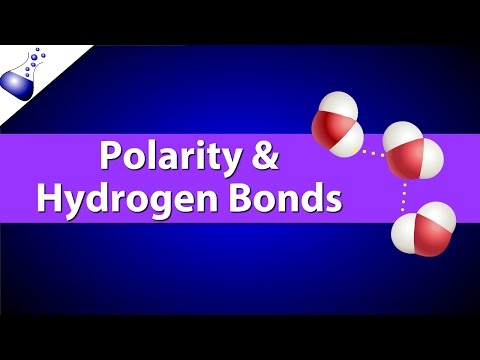
This causes the bond between the oxygen and hydrogen to become This causes the bond between the oxygen and hydrogen to become polar. The term polar simply means that the atoms on either side of the bond have a partial and opposite charge. Now lets put this water molecule in an environment with other water molecules. Notice that the water molecules orient
themselves so that the negative end of one water molecule is opposite the positive end of another water molecule. When water molecules orient themselves in this manner, a weak attractive force, called a hydrogen bond, is formed. In water, hydrogen bonds are abundant. Each water molecule can engage in as many as four hydrogen bonds. However,
Transcribe another video
Paste any YouTube, Instagram or TikTok link to get a free transcript.