The Incredible Strength of Bolted Joints
The Efficient Engineer · 2,684 words · 13 min read · EN
Below is the complete, readable transcript of The Incredible Strength of Bolted Joints by The Efficient Engineer on YouTube. Read the full text, copy any part you need, or generate a transcript for any video with our free tool.
Nuts and bolts are extremely simple pieces of hardware that are actually quite incredible. Not only are they really cheap, they create joints that can be disassembled and reassembled multiple times, and a well designed joint can transmit huge forces without failing. So it's no surprise that bolted joints are used in everything from the most basic,
to the most challenging engineering applications.
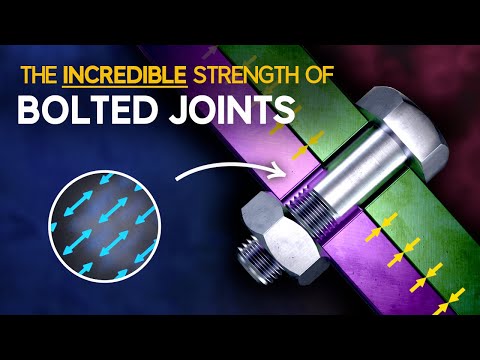
But there's more to them than you might think. And it all starts with the assembly process. Here's a simple bolted joint, where the fastener, in this case a single bolt, passes through holes in two plates and is secured with a nut to complete the assembly. Let's look closely at what happens when the nut is tightened. As it's turned, the threads on the bolt
and the nut engage, and rotation of the nut pulls the bolt threads down, which causes the bolt to stretch. This stretching creates a tensile force in the bolt, pulling the two joined members into contact with one another and compressing them. The same thing happens for screws in threaded holes, except the tensile force is generated by tightening the screw instead of a nut.
This tensile force in the fastener is called preload. It's intentionally applied to the bolt or screw before any external loads that act on the joint. Preload is surprisingly powerful. It makes the joint stronger, more resistant to fatigue damage, and much less likely to fail. The exact way the preload force works to improve the load carrying capacity of a
joint depends on how the joint is loaded. Joints are usually grouped into two categories - if the load acts along the axis of the bolt it's a tension joint, and if it acts perpendicular to the axis it's a shear joint. Let's look at tension joints first. In these joints, the applied load is trying to pull the two joined components apart.
Transcribe another video
Paste any YouTube, Instagram or TikTok link to get a free transcript.