Understanding Viscosity
The Efficient Engineer · 1,795 words · 9 min read · EN
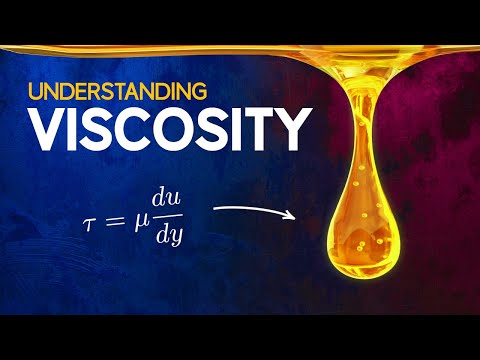
Below is the complete, readable transcript of Understanding Viscosity by The Efficient Engineer on YouTube. Read the full text, copy any part you need, or generate a transcript for any video with our free tool.
Thanks to CuriosityStream for sponsoring this video. Everyone has an intuitive understanding of what the viscosity of a fluid is. Honey is more viscous than oil, and oil is more viscous than water. Viscous fluids feel thicker, and don't flow as easily. But since it's such a fundamental parameter that defines how fluids behave, it's worth
developing a more in depth-understanding of viscosity. To do this, let's start by looking at fluid flowing over a flat surface. It's sometimes useful to think of fluid as flowing in layers, with each layer moving at a different velocity. When two layers are moving relative to one another because they're flowing at different velocities, a shear stress develops between them.
This is similar to how a frictional force develops between two solid objects sliding relative to one another. The effect of this shear stress is most obvious in flow close to a wall. The wall imparts a large shear stress onto the fluid particles that are in contact with it, causing them to have zero velocity.
This is called the no-sIip condition. The large shear stress is transmitted through to adjacent layers of flow, slowing down flow close to the wall and resulting in a velocity profile that looks like this. The magnitude of the shear stress acting between the layers of the fluid is closely linked to the slope of the velocity profile, du/dy, where u is the fluid velocity and y is the
distance from the wall. The slope is small in the free stream. The fluid layers are moving at almost exactly the same velocity, and so the shear stress will also be very small. But close to the wall the velocity changes very suddenly. In this region the slope is large, and so the shear stress is also large.
Transcribe another video
Paste any YouTube, Instagram or TikTok link to get a free transcript.