Hawthorne Effect Explained: The Psychology Experiment That Changes Behavior
Simplify and Succeed · 286 words · 1 min read · EN-US
Below is the complete, readable transcript of Hawthorne Effect Explained: The Psychology Experiment That Changes Behavior by Simplify and Succeed on YouTube. Read the full text, copy any part you need, or generate a transcript for any video with our free tool.
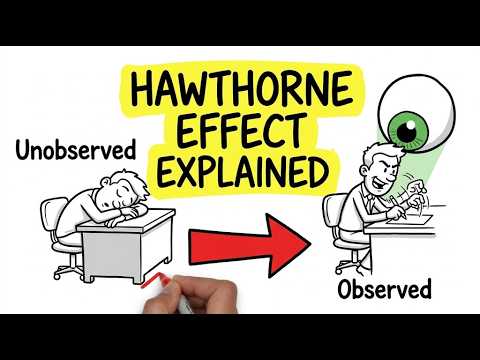
Have you ever noticed you work harder when the boss is watching? It’s not just you. This psychological glitch has a name, and it ruins scientific research. Welcome to the hawthorne effect explained. It completely flips how we understand human behavior, and it started in a simple factory almost a century ago. So, what is it? The hawthorne effect
psychology happens when individuals change or improve their behavior simply because they know they are being observed. It’s not about the lighting, the pay, or the breaks. The real variable causing the spike in performance is the spotlight of attention. Let’s look at the famous hawthorne effect experiment. In the nineteen twenties, researchers at the Hawthorne Works factory
wanted to see if brighter lights made workers assemble relays much faster. They turned the lights up, and productivity skyrocketed. But then, they dimmed the lights down to moonlight levels. Surprisingly, productivity went up yet again! Why? The workers weren't reacting to the physical environment. They felt valued because experts were studying them. Attention was the ultimate performance enhancer,
not the actual lights. This discovery revolutionized the hawthorne effect in management. Leaders realized that treating employees like cogs in a machine was far less effective than showing genuine interest in them. When managers actively observe and engage with their teams, performance naturally rises. Observation acts like a psychological catalyst, sparking motivation that invisible systems simply cannot generate.
However, there is a catch. This boost is usually temporary. Once the researchers leave or the boss looks away, the novelty fades and productivity returns to normal. So, the next time you design a new process, ask yourself: are they really improving, or are they just reacting to you watching them work?
Transcribe another video
Paste any YouTube, Instagram or TikTok link to get a free transcript.