VIGAS_FUERZA CORTANTE Y MOMENTO FLEXIONANTE (flector)
Ing. Susano Alvarez · 2,102 words · 11 min read · EN
Below is the complete, readable transcript of VIGAS_FUERZA CORTANTE Y MOMENTO FLEXIONANTE (flector) by Ing. Susano Alvarez on YouTube. Read the full text, copy any part you need, or generate a transcript for any video with our free tool.
Hello, welcome to this video about beams. First, we'll see an introduction to beams, an analysis, and finally, the definition of a beam. A beam is a structural element designed to support loads along its length. These loads, which are on the element called the span, will cause two phenomena: one phenomenon will be the
shearing of the beam due to the action of these forces, and the other will be bending. That is, p1 and p2 are equal to the loads. What is in blue is the beam, and these little triangles are the supports. The span is the distance between the supports, also called the distance. The forces acting on
the beam, which are placed on the span, will cause two phenomena: one will be the shearing of the beam, also known as shear force; the other phenomenon caused by these forces is the bending of the beam, which is called bending moment. Before solving an exercise, in this exercise we will calculate the shear force, which is represented
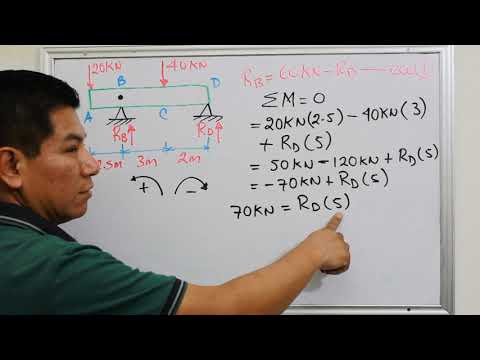
by the letter v. We will see where the span can be cut. We will also calculate the bending moment. Flexure before and the capital letter m where that life will be reflected according to the forces are applied on the friend for this first we will have to calculate the reactions at the support points that is to say we will
calculate the forces that are given from the action of these forces on the beam we will call in the first support r ven which is the reaction at the support b&r of subscript of which is the reaction that will be given as a result at the point for this we will need the
conditions of equilibrium with 3 m is equal to zero the sum of forces in y which is equal to zero and the sum of moments equal to zero we start with the first condition which is the sum of forces in x in this case we are not going to use the sum of forces in x because there is no
Transcribe another video
Paste any YouTube, Instagram or TikTok link to get a free transcript.