IEE 380 Ch 4 Continuous Mean Variance Std Dev
Dr C · 1,806 words · 9 min read · EN
Below is the complete, readable transcript of IEE 380 Ch 4 Continuous Mean Variance Std Dev by Dr C on YouTube. Read the full text, copy any part you need, or generate a transcript for any video with our free tool.
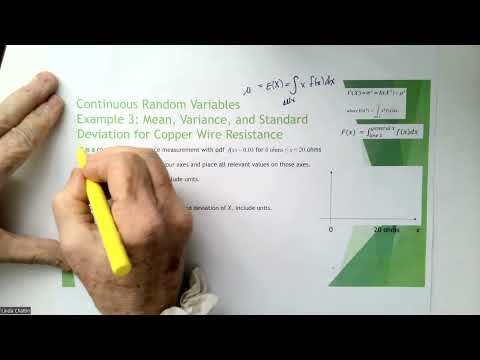
okay so in this little video we are going to learn how to compute the mean and the variance and the standard deviation of a continuous random variable um so let's see here if x is continuous random variable with probability density function scripted f of x the population has the same terms by the way so we'll
call it the population mean and sometimes I put this in parentheses we can just the book just calls it the mean it's also called the expected value of X it's also called mu and this is the um notation and this is familiar to you from the discrete random variables uh remember though or I want to do a little
I like to do these little recall things recall that if x is discrete the way we got the expected value which we also call the mean the way we got that was we summed over all of our values of X all the range take each value and multiply it by its probability so for continuous it's similar you
remember this from calculus summation for discrete is equivalent to an integral for uh continuous and so this is how you'll get it it has the same units as random variable X just like it was with discrete random variables the formula for variance and standard deviation of a continuous random variable also is almost exactly the same the only
difference is that what we did when it was discrete we summed over all of X here um well let me just remind you here because it's good to see this so I'll say recall when X is discrete these formulas look like this the fancy formula the definitional formula looked like this it was oh well sum over all of
my range of X will take each x minus its mean Square it and then we would multiply it by the probability Mass function now what we're going to do instead of summing is we're going to integrate and we're going to call it a probability density function then same thing for expected value of x squared we
Transcribe another video
Paste any YouTube, Instagram or TikTok link to get a free transcript.