Everyone is Talking About The New Anker Solix S5000 Power Station - Here's Why
Watt's Next? · 2,562 words · 13 min read · EN-ORIG
Below is the complete, readable transcript of Everyone is Talking About The New Anker Solix S5000 Power Station - Here's Why by Watt's Next? on YouTube. Read the full text, copy any part you need, or generate a transcript for any video with our free tool.
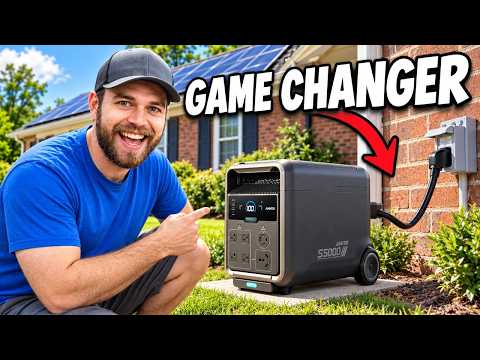
Anker Solix just dropped a new power station that's small enough to fit just about anywhere, but also capable of powering your house. It has 5,024 watt hours of battery capacity. It can put out 4,500 running watts and surge up to 8,000 watts. It powers 120 volt and 240 volt stuff, and it's rechargeable with
solar panels. Plus, they claim it's the longest-lasting 5 kWh power station, and it can power your house for up to 48 hours. So, what's the catch? Well, in this video, I'm going to push it to the limits and see how long it'll power my house, my fridge, and more. First, let me rewind a little bit and show you what
comes in the box. I am actually so excited about this because this is my first Anker Solix power station. So, let's see what the hype is all about. Solar charging cable and AC charging cable. It's actually surprisingly small for a 5,000 watt hour battery. Yeah, look how compact this thing is. That's pretty impressive. And it does have a
suitcase handle, so you can roll it around. I'm not going to pretend like it's fun to pick this thing up, but for a 5,000 watt hour battery, surprisingly not that heavy. Okay, so on the front, we've got one USB A outlet, two USB C outlets, four AC outlets. We've got one of these
three-prong RV outlets. And then we also have one 240 volt outlet. On the back, we've got our AC input, so you can charge it from the wall. This flap is where you can connect expansion batteries. You can connect up to five of them for up to 30 kWh of battery capacity. You can also connect a smart
generator. And then this flap is our solar input. Out of the box, we are at 26% charged, and we need to fully charge it before we begin powering anything. So, I'm going to start with solar panels. So, we've got two solar input ports. This one on the bottom is an XT60 port. It can only take up to 60 volts
Transcribe another video
Paste any YouTube, Instagram or TikTok link to get a free transcript.