Materia y tabla periódica II
Ana Carolina Campos Alba · 4,137 words · 21 min read · EN
Below is the complete, readable transcript of Materia y tabla periódica II by Ana Carolina Campos Alba on YouTube. Read the full text, copy any part you need, or generate a transcript for any video with our free tool.
Okay, so we'll continue with our activity. Let's see if our interactive allows us. We're going to look at seawater. So, would that be granite? What do you think? Which of the 48 in Tzintzuntzan will it be? Which will be heterogeneous? Orange juice? That sulfur is in the food in the coin? To make an alloy? Where, where, where, pin? Let's go
with it. Another one is calcite. Where was the space for calcite? Let's go with gas or oxygen, the nitrate of cones. Here we have a clear example of how we can place different substances, elements, and mixtures in each of the different types of matter, as we can observe here. So, we continue with
our activity. Don't forget these examples. Whenever there is a doubt, then we must go back to the concept to be able to know what I am going to familiarize you with. Different, and you don't know, distinctly, is to be in this family or in this one because of its characteristics, as we saw in Carrera.
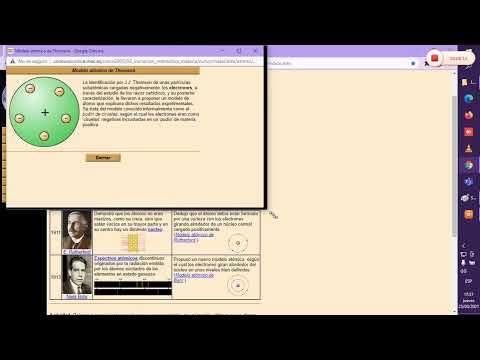
Very good. So, let's see the other part. This is the history of atomic models. So, you have already seen on the virtual campus the whole journey, this super arduous journey that these scientists went through to be able to make what we know as atomic notation. The atom and its entire structure, and how that has allowed us to
have scientific advances. Important dates to keep in mind: 1808, 1897, 1911, 1901, and 1913. This refers to atomic theory, and that goes back to the scientist John Dalton in the 18th century—or rather, that was yesterday. He spoke about the following: there were three postulates of the classical laws of chemistry. The first was
the law of conservation of mass. I have that. A chemical reaction is composed of reactants (our little arrow) and products. The remaining reactants will always be to the left of the arrow, and the products to the right. The arrow allows us to know where the reaction is going. Sometimes there are irreversible reactions, like this one, meaning they
Transcribe another video
Paste any YouTube, Instagram or TikTok link to get a free transcript.