Understanding the Area Moment of Inertia
The Efficient Engineer · 1,718 words · 9 min read · EN-ORIG
Below is the complete, readable transcript of Understanding the Area Moment of Inertia by The Efficient Engineer on YouTube. Read the full text, copy any part you need, or generate a transcript for any video with our free tool.
let's say we have a plank of wood which we would like to use to cross a canal it has a rectangular cross-section and so we could either use it like we have done here or we could rotate it onto its side like this intuitively we can tell that the plank will be stiffer if the load is
applied to the shorter side of the cross section some cross sections are much more efficient at resisting bending than others the further the material is spread from the bending axis the stiffer a cross section tends to be the cross section on the right has more material located far from the bending axis and so is better
at resisting bending even though both cross sections have the same area this concept of resistance to bending can be quantified by calculating the area moment of inertia which is also sometimes called the second moment of area the area moment of inertia reflects how the area of a cross section is distributed relative to a particular
axis and so is a measure of how much resistance the cross section has to bending the i-beam locates the majority of the material as far as possible from the bending axis and so is a very efficient cross section this is why it is so commonly used in construction in this video we're going to take a
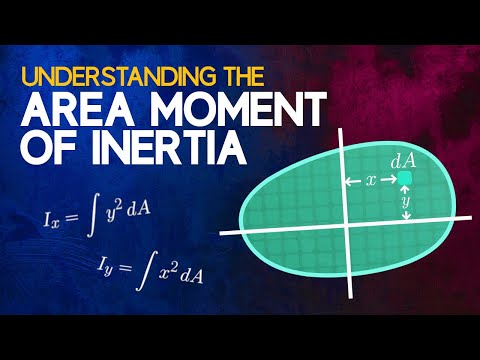
detailed look at the area moment of inertia let's start by seeing how it can be calculated for an arbitrary cross section like the one shown here the first thing to note is that the area moment of inertia is not a unique property of a cross section it quantifies the resistance to bending about a particular axis and so it's
value changes depending on where we place this reference axis we can approximate the area moment of inertia of a cross section by splitting it into small elements each element contributes to the total area moment of inertia by a quantity equal to its area da x y squared where Y is the distance to the
Transcribe another video
Paste any YouTube, Instagram or TikTok link to get a free transcript.