Lecture 2, Signals and Systems: Part 1 | MIT RES.6.007 Signals and Systems, Spring 2011
MIT OpenCourseWare · 5,415 words · 27 min read · EN-ORIG
Below is the complete, readable transcript of Lecture 2, Signals and Systems: Part 1 | MIT RES.6.007 Signals and Systems, Spring 2011 by MIT OpenCourseWare on YouTube. Read the full text, copy any part you need, or generate a transcript for any video with our free tool.
The following content is provided under a Creative Commons license. Your support will help MIT Open Courseware continue to offer high-quality educational resources for free. To make a donation or view additional materials from hundreds of MIT courses, visit MIT Open Courseware at ocw.mit.edu.
In the last lecture, I introduced and illustrated the kinds of signals and systems that we'll be dealing with throughout this course. In today's lecture, I'd like to be a little more specific and in particular talk about some of the basic signals, both continuous time and discrete time, that will form important building blocks
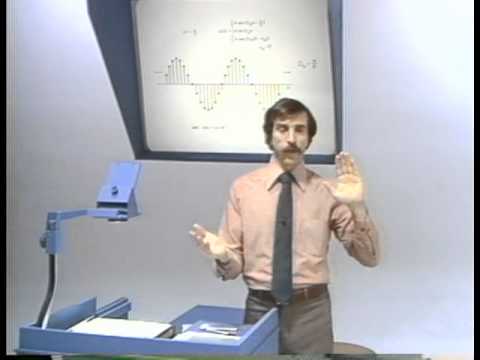
as the course progresses. Let's begin with one signal, the continuous time sinusoidal signal, which perhaps you're already somewhat familiar with. Mathematically, the continuous time sinusoidal signal is expressed as I've indicated here. There are three parameters, A, omega zero, and phi. The parameter A is referred to as the amplitude, the parameter omega zero as the
frequency, and the parameter phi as the phase. And graphically, the continuous time sinusoidal signal has the form shown here. Now, the sinusoidal signal has a number of important properties that we'll find it convenient to exploit as the course goes along. One of which is the fact that the sinusoidal signal is what is referred to
as periodic. What I mean by periodic is that under an appropriate time shift, which I indicate here as T zero, the signal replicates or repeats itself, or said in another way, if we shift the time origin by an appropriate amount T zero, the smallest value of T zero being referred to as the period, then X of T
Transcribe another video
Paste any YouTube, Instagram or TikTok link to get a free transcript.